
The human brain is an incredible organ, but it was never designed to handle the sheer volume of data we throw at it today. Between tracking complex digital environments, analyzing fast-moving market trends, and trying to memorize dense academic syllabi, your prefrontal cortex—the area of the brain responsible for deep focus and decision-making—can easily run out of steam. When high-stress weeks hit, conventional advice tells you to simply “study harder” or “grind longer.” However, cognitive science shows that brute-force effort often backfires, leading to extreme mental exhaustion, lower retention rates, and critical mistakes in your work. Surviving and thriving during these high-stakes periods requires a deliberate strategy based on neurological principles rather than raw willpower.
To understand how to optimize your brain during these intense periods, we have to look at how mental energy is used and depleted. Every single decision you make, from choosing what to eat to analyzing a complex data set, burns a measurable amount of glucose. When your brain is constantly forced to switch back and forth between disparate tasks, it experiences what cognitive scientists call task-switching costs. This rapid switching drains your mental battery at an accelerated rate, leaving you with severe writer’s block or mental paralysis when you sit down to tackle a difficult paper. For instance, if you are attempting to pivot directly from an intense technical project to a deeply creative piece of writing, the residual mental friction can make it almost impossible to produce high-quality work.
During these times of extreme academic overload, finding clever ways to optimize your time and reduce this cognitive burden is essential. If a student is completely bogged down by a massive workload, seeking specialized marketing assignment help from myassignmenthelp can be a game-changing tactical move to offload complex analytical projects, allowing them to instantly reclaim their focus and preserve their executive brainpower for high-priority exams.
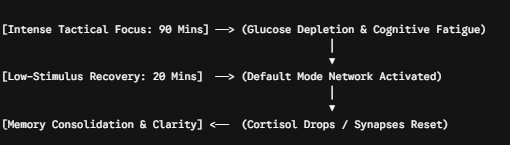
One of the most effective ways to counteract this mental drain is by building a structured routine based on the biology of human attention. Our brains do not naturally focus for eight hours straight; instead, they operate on what are known as ultradian rhythms. These are natural biological cycles where our alertness peaks for roughly 90 minutes before dipping into a 15-to-20-minute period of fatigue. High-performance students and professionals tap into this science by using targeted study blocks. Instead of forcing yourself to look at a textbook for four hours without a break, you set a timer for 90 minutes of absolute, distraction-free focus. Once that timer goes off, you completely step away from the desk to let your neural pathways rest and process the information you just consumed.
The Neurological Impact of Chronic Multi-Tasking
Many people wear multi-tasking like a badge of honor, but research out of Stanford University has proven that the human brain cannot actually process two cognitively demanding tasks at the exact same time. What we call multi-tasking is actually task-switching, and it comes with a massive neurological penalty. Each time you glance at a notification while trying to read a research paper, your brain has to disconnect from the academic material, load the context of the notification, and then attempt to re-load the academic context when you look back at your book.
This constant context switching floods your system with cortisol and adrenaline—the body’s primary stress hormones. While a small amount of stress can sharpen your short-term focus, chronic levels of these hormones actively impair your working memory and shrink the neural connections inside your hippocampus, the brain’s primary memory center. This explains why, after a long day of juggling open tabs, emails, and chat notifications, you can stare at a single page of text for half an hour without actually absorbing a single sentence. To build a true brain hack routine, you must create a zero-distraction environment by putting your phone in another room and closing every browser tab that isn’t directly related to your current task.
The Dopamine Feedback Loop: Gaming vs. Studying
To truly understand student productivity, we have to look at the neurotransmitter called dopamine. Dopamine is the chemical molecule of anticipation and motivation. In highly interactive environments, like trading rare digital cosmetics on gaming marketplaces or securing a tough win in a ranked competitive match, the brain receives rapid, predictable bursts of dopamine. Every successful trade or ranked victory acts as an immediate neurological reward.
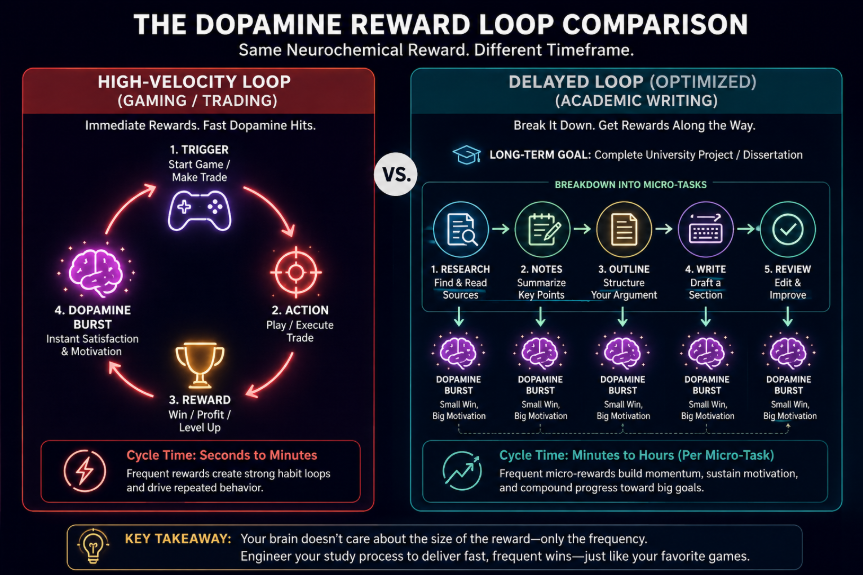
In stark contrast, working on a long-term university task, like an extensive research paper, offers very little immediate feedback. The reward—a good grade or passing the course—is weeks or months away. This creates a massive motivational imbalance. When your brain is accustomed to high-velocity feedback loops, sitting down to read a dense textbook feels incredibly under-stimulating. The brain hack solution here is “dopamine micro-dosing.” By breaking down a massive 2,000-word essay project into microscopic, actionable steps (such as finding just three sources, or writing a single introductory paragraph), you create clear finish lines. Checking off these tiny items triggers a small, localized dopamine release, mimicking the reward structure of a competitive game and keeping your focus steady throughout the day.
Leveraging Strategic Nutritional Frameworks for Mental Clarity
The fuel you put into your body directly dictates how long your brain can sustain high-level processing during a high-stress week. When deadlines approach, the natural temptation is to rely heavily on energy drinks, sugary coffee creations, and processed snacks to keep going. While these items provide an immediate spike in alertness, they trigger a massive insulin release that causes a severe blood sugar crash shortly after. This crash leaves you feeling incredibly sluggish, anxious, and cognitively foggy right when you need to be at your sharpest.
Neuroscientists recommend focusing on foods that provide a slow, steady release of energy to maintain consistent cognitive performance. Combining complex carbohydrates with healthy fats and clean proteins—like oatmeal with walnuts, or eggs with whole-grain toast—ensures a stable supply of glucose to your brain over several hours. Additionally, your brain is composed of roughly 75% water, meaning even mild dehydration can impair your short-term memory, attention span, and processing speed. Keeping a large water bottle at your desk and drinking from it regularly throughout your study sessions is one of the simplest yet most overlooked ways to prevent mid-day mental fatigue.
Maximizing Sleep Architecture for Memory Consolidation
No matter how many productivity apps you download or how tightly you manage your schedule, you cannot out-hack a chronic lack of sleep. When you sleep, your brain doesn’t just shut off; it goes into a massive internal cleanup mode. During the deep stages of non-REM sleep, the brain activates its glymphatic system, which essentially washes away metabolic waste products that build up between your neurons during waking hours.
Furthermore, sleep is the exact time when your brain moves information from your temporary short-term storage into your permanent long-term memory network. If you pull an all-nighter to cram for a test or write an essay, you are actively robbing your brain of the opportunity to solidify that data. This is why students who sleep for seven to eight hours consistently outperform those who stay up all night, even if the cram session felt incredibly productive at the time. To maximize your sleep quality during a high-stress week, establish a hard digital curfew by turning off all screens at least 45 minutes before bed. The blue light emitted by phones and computers tricks your brain into thinking it is still daytime, suppressing the natural production of melatonin and ruining your sleep architecture.
Tactical Scheduling and Task Delegation
To get the most out of your week, you need to look at your workload through a structural lens. High-performing students do not treat all tasks equally. They filter their responsibilities through a strategic prioritization model to decide what deserves their peak creative energy, what requires routine processing, and what can be systematically offloaded to external support infrastructure.
When the sheer volume of deadlines becomes too heavy to handle alongside your core studies, forcing your way through the fatigue only creates a bottleneck of poor quality work. Knowing when to look for external support or finding a reliable expert to do my assignment ensures that your formatting, reference sorting, and secondary research remain completely flawless. This simple operational pivot removes unnecessary friction from your schedule, keeping your mind fresh for critical exams.
The Academic Delegation Matrix
| High Urgency | Low Urgency | |
| High Complexity | Peak Focus Zone: • Core exams and presentations • Finalizing thesis arguments • Heavy programming assignments | Strategic Planning Zone: • Early literature reviews • Outline upcoming course projects • Reading foundational chapters |
| Low Complexity | Tactical Delegation Zone: • Formatting citations and bibliographies • Proofreading and spell-checking • Routine data entry and data sorting | Batching Zone: • Organizing digital files • Replying to course emails • Cleaning up study workspaces |
Structuring Your High-Performance Task Flow
To successfully navigate an intense week without burning out, you need to structure your daily agenda based on your natural biological peaks. Most individuals experience their highest levels of alertness and mental clarity during the morning hours, making this the prime window for deep-work tasks like writing, coding, or analyzing complex data. Saving your most difficult, brain-heavy tasks for these peak hours ensures that you tackle them with a completely fresh mind.
| Time Window | Cognitive State | Optimal Task Types | Specific Examples |
| Morning (Peak Focus) | High dopamine and cortisol levels, peak executive function. | Draft papers, study complex concepts, outline projects. | Writing a marketing case study, learning a new math formula. |
| Afternoon (The Dip) | Natural circadian drop in energy and alertness. | Organize files, respond to emails, format references. | Sorting out research citations, cleaning your study desk. |
| Evening (Recovery) | Lower analytical focus, potential creative spike. | Review notes, plan the next day’s schedule, unwind. | Reading over lecture slides, setting tomorrow’s 90-minute blocks. |
As you move into the afternoon, your body goes through a natural circadian dip, causing a temporary drop in core body temperature and alertness. Instead of fighting this slump with more caffeine, use this lower-energy window to complete routine administrative tasks that do not require intense critical thinking, such as sorting files, organizing your workspace, or checking off basic logistics. By matching the difficulty of your tasks to your daily biological energy levels, you eliminate unnecessary friction, reduce daily stress, and create a sustainable workflow that allows you to crush your goals week after week.
Frequently Asked Questions
1. What is an ultradian rhythm and how does it help focus?
An ultradian rhythm is a natural, 90-minute biological cycle where your brain operates at peak alertness. Structuring your work into 90-minute blocks followed by a brief rest prevents executive burnout and keeps your attention sharp.
2. Why does multi-tasking make me feel so exhausted?
Your brain cannot process two complex tasks simultaneously. Constantly switching between tasks forces your mind to repeatedly load new context, which drains glucose, spikes stress hormones, and causes rapid cognitive fatigue.
3. What constitutes a high-quality recovery break?
A true recovery break requires low-stimulation activities like deep breathing, stretching, or walking. Checking social media or reading news continues to flood your brain with processing data, preventing actual mental rest.
4. How does sleep affect my long-term memory?
During deep sleep, your brain consolidates information by moving data from temporary short-term storage into permanent memory networks. Skipping sleep actively disrupts this process, causing you to forget what you studied.
About The Author
Emma Jones is a senior academic advisor and content specialist at myassignmenthelp. She has spent over a decade helping university students optimize their study habits, conquer writer’s block, and achieve peak productivity during intense examination terms.